
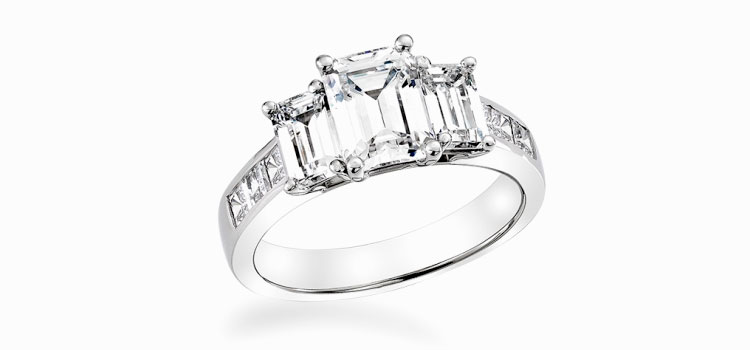
If you’ve been reading our blog with any sort of frequency whatsoever, then you’ve probably noticed a trend: we talk about cubic zirconia jewelry a lot. Maybe it’s caught your attention, maybe it hasn’t. If the latter is the case, it might just be because you aren’t familiar with cubic zirconia or “cz” jewelry. This may surprise you, but just like diamonds and other “real” gemstones, there are a variety of different kinds of cz, and brushing up on them will help you to better understand what your options are and make more informed decisions when you’re jewelry shopping.
What Is Cubic Zirconia?
You’re probably already aware that cubic zirconia is a more affordable substitute for diamonds. What you may not know is how cz differs from diamonds. CZ is heavier but softer than a diamond of the same size. CZ is free of the inclusions that are present in even the most pristine of diamonds. In other ways, it can be exactly like diamonds. All cubic zirconia is available in a variety of cuts, colors and carats.
The best CZ, known as Russian Formula cubic zirconia, shines as brightly as diamonds do. Of course, not all cz is of the Russian Formula. There are several different types. But before we dig into them, let’s step back and talk about the real thing for a moment.
Real/Natural Gemstones
As the name implies, real or natural gemstones are those that are naturally occurring. Real stones are able to be treated using a number of both permanent and non-permanent methods to make color hues look more desirable. Tanzanite, for instance, appears a brownish color in its natural form, but it takes on an incredible purple-blue hue when treated with enough heat.
Lab-Created Gemstones
Composed of the same exact composition as real/natural gemstones are, lab-created stones are created in a – you guessed it – lab. Special equipment that emulates the high pressures and temperatures used by nature deep within the Earth’s crust to slowly form gemstones over many, many, many years is used in these labs. Lab stones are perfect doppelgangers to natural ones when it comes to hardness, luster, composition, appearance and color.
The sole difference between the two?Natural gemstones almost always have some sort of imperfections to them, whereas lab-created gems are flawless. They’re able to be created free of inclusions because the pressure and heat are tightly controlled in laboratories to ensure that the stones come out looking absolutely perfect – a little too perfect if you know what you’re looking at.
It’s a strange thing, of course, that imperfect natural stones are worth far more money than impeccable lab-created gems. This, however, is because natural gemstones are rare things that must be found and dug up. Lab stones, on the other hand, are available in abundance. In fact, it’s fair to say that, for some types of lab-created gemstones, their availability is limited only to the amount producers can sell.
Sapphires and rubies are particularly easy to create in laboratories, so their lab-created versions exist in even greater abundance than some other stones do. Aquamarines and emeralds, however, are more difficult to create in a lab, so fewer are available. Compounding the issue is that emeralds are very costly to produce in a lab.
Simulated Gemstones
Lab creations are not the only type of alternative jewelry, though. Simulated gemstones – which are also, ironically, created in laboratories –differ from natural and lab-created stones in several key ways. Simulated stones are made to look like natural gems, but, in most cases, they do not possess the same hardness, luster, aesthetic or composition of real gems.
Russian Formula cubic zirconia, however, is the absolute finest of alternative jewels, setting the standard for clarity, brilliance and cut for about four and a half decades now. These stones never lose their color or brilliance and shine every bit as bright as real diamonds do.
Completely natural stones come in an incredibly diverse array of shades, and so it is with Russian Formula cz. It’s an accomplishment that’s possible thanks to the vacuum induction that’s used to create Russian Formula cz. This incredibly sophisticated piece of equipment results in the cz coming in a multitude of shades from dark to light, just like the real thing.
Diamonds aren’t the only stones that can be simulated, of course. Rubies, sapphires, emeralds and more can be created through this process and have permanent coloring added to them at precisely the right time during the process to ensure that the color is found throughout the entire gem, rather than just on its surface.
Russian Formula
At Birkat Elyon, our collection is comprised of only Russian Formula cz jewelry. It’s the only one of the five methods of simulated gemstone creation that results in stones that catch the light so beautifully that not even experienced gemologists can readily tell them apart from diamonds without special equipment.