
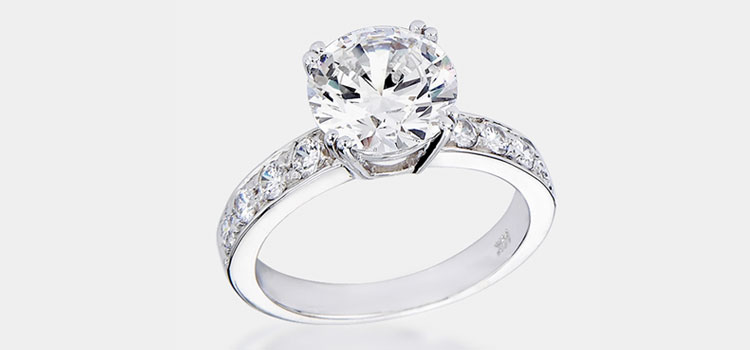
A few weeks ago we talked about the Big Four C’s of precious and semi-precious gemstone buying: cut, clarity, carat and color. These elements help to determine the value of any particular stone. Pricing can range from a few hundred to a few thousand to tens of thousands of dollars depending on how a stone stacks up in these key factors.
Bigger carats, higher clarity, finer cuts and balanced colors each tend to drive up the value of any given stone. It’s extremely difficult to find a stone that excels in all four of these categories, since compromises must usually be made in one area in order to satisfy another. For instance, deeper cuts can make for a stone with a more brilliant color but one that’s cut less will have more carats. And even if you are to discover a stone with a near perfect balance between the Four C’s, you’re going to be looking at an astoundingly high price tag.
Of course, you do have an alternative option. You have Birkat Elyon and our enormous collection of high-end cubic zirconia rings, pendants, bracelets, necklaces, earrings and brooches. Our cuts are exquisite, our colors perfect, our clarity flawless and our bands are 14K or 18K genuine white or yellow gold.
Carats and Clarity
But let’s take a step back and examine two of the most desirable measurements of a stones’ worth and beauty: carats and clarity.
Carats are the standard measure of a gemstone’s weight. As you’re probably well aware, more carats means more rare which means more expensive. A single carat is equal to 200 milligrams and has 100 points. That means a diamond ring with 50 points weighs in at .50 carats. Thanks to other factors like clarity, two stones with identical carat weights have the potential to vary greatly in price.
It’s normal for diamonds to have diminutive natural characteristics known as “inclusions.” Trained eyes relying on powerful magnifying glasses can identify the precise position, nature, color, number and size of inclusions. This allows them to assign clarity grades to gemstones. Those stones with fewer and smaller inclusions (and surface blemishes) are more highly valued and will in turn cost more to procure.
Measuring Clarity
The Gemological Institute of America (GIA) has a thing for clarity – it created the clarity scale that measure internal purity – and you probably do as well. After all, aren’t we all looking for as close to perfection as possible? The American Gem Society certainly is, as it established its own numerical clarity system that relies on the same standards as the Gemological Institute of America.
Under the GIA system, flawless diamonds are bereft of inclusions or blemishes that are visible by a trained grader under 10x magnification. A step down from that grade, Internally Flawless (IF) stones are those with no inclusions and having only blemishes visible under 10x magnification. Very, Very Slightly Included (VVS1 and VVS2) diamonds have only minute inclusions, which are tricky for even skilled graders to spot. Very Slight Included (VS1 and VS2) have minor inclusions that can be either tough or relatively easy to see. Slightly Included (SI1 and SI2) have noticeable inclusions that be easily or extremely easily seen. Finally, Included (I1, I2 and I3) have inclusions that are essentially impossible to miss under 10x magnification.
Understanding what the different grades mean is important for any prospective jewelry buyer, since it is extremely difficult for the untrained eye to accurately evaluate clarity, and basically impossible without the right magnifier.
Making the Cut
Diamonds and high-end cubic zirconia can be strikingly beautiful when they’re cut properly, like those available in the Birkat Elyon online store. When the light hits the stone just right it creates a dazzling effect that appears as a rainbow-like flash and burst of shimmering light. There is no sight quite like it – if the cut is right, that is.
Though this impossible-to-miss look is straightforward, a stone’s cut is a complicated matter. Contrary to popular belief, there is more to cut than a precious stone or cubic zirconia’s shape or visible outline. Faceting, finish (also known as “make”), proportion and symmetry also play into the equation.
Brilliant cuts are the most highly sought after thanks to them being designed for supreme sparkle, an effect that is achieved through a multitude of kite-shaped and triangular facets. Step cut, meanwhile, is meant to boost a diamond’s elegance through the usage of fewer facets, instead going heavy on trapezoids and rectangles. Mixed is, well, it’s a mix of the two, and it is employed to find a compromise between them in order to present the best of both worlds.
Regardless of which cut you’re looking at it’s crucial to make sure it’s one that does not vary too much from the accepted standards. Too much variance leads to a loss of light through the bottom or sides, reducing the sparkle and splendor of the gemstone.
Now that you have a better understanding of cut and clarity specifications you can ensure you get exactly what you or your special someone is looking for in a diamond. And if you’re looking for an affordable alternative with the same look, you’ll find the high-quality cubic zirconia with the qualities you want right here at Birkat Elyon!