
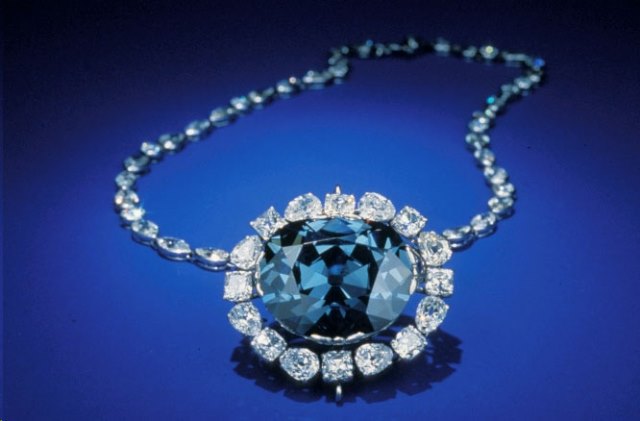
There are many beautiful diamonds in the world. Maybe you’re lucky enough to even have a few of them in your own collection. Regardless of what is or isn’t in your personal jewelry box, though, you can always appreciate the shine of the finest diamonds. And there is perhaps no diamond that has been ogled more than the famous Hope Diamond has been over the years.
At 45.52 carats, it’s little wonder why the Hope Diamond has garnered so much attention. It’s impossible to see the massive rock and not have your curiosity piqued. Where did this huge gem come from? What’s its story? And…
Why Is It Called Hope?
Like most extremely valuable things in life, the Hope Diamond was once owned by a wealthy family. Also not unlike many things in life, it’s named after someone wealthy. Sometime around 1939 – no one is certain of the exact date – the bright blue diamond came under the ownership of one Henry Philip Hope, who was an heir to the banking firm Hope & Co.
But before we dig any deeper into that story, let’s back things up, say, around 270 years.
Background
It’s commonly accepted among scholars that King Louis XIV of France purchased the Hope Diamond in 1668. If true, it is indeed good to be the king. Of course, King Louis XVI might disagree with that assessment. In 1791 whenKing Louis and Marie Antoinette had no choice but to flee revolutionaries – who were presumably none too happy about Marie’s whole “Let them eat cake” business – they made it only as far as the small town of Varennes, France. Once there, the royal family was arrested, and the diamond was confiscated.
The French government enjoyed ownership of the gem for a whole year before it was plucked from their grasp. It would not turn up again until 1812, this time across the Channel in London. At least, it’s believed that it turned up again in London. It’s impossible to know for certain whether or not it’s the same stone, but evidence strongly indicates that it is. Even if it’s not, though, what did turn up was still one heck of a magnificent diamond, so few are losing sleep over it.
After passing through a number of other owners, including Hope, it would eventually come into the possession of jeweler Harry Winston who donated it to the Smithsonian, where it rests today. Astoundingly, he transferred it by simply dropping it into a paper wrapper and sending it registered mail.
“It’s the safest way to mail gems,” said Winston.“I’ve sent gems all over the world that way.”
Some, however, believe that “safe” and the Hope Diamond don’t even belong in the same sentence.
The Curse
Legend has it that the diamond was once ripped out of an Indian idol, and that it has been cursed ever since. A few hundred years ago, a gentleman named Tavernier took a fun little trip to India. Fun in that he took back with him one of the world’s largest diamonds. Yes, good ol’ Tavernier allegedly grabbed the blue beauty from the forehead of a statue of the Hindu goddess Sita. After he sold what would later become known as the Hope Diamond, the thief is said to have been – and this is rather unpleasant – torn apart by wild dogs while visiting Russia.
Of course, that’s just one version of the story.
Historians contend that what actually happened was in 1642 the French jeweler Jean Baptiste Tavernier visited India and bought a 112-carat blue diamond. The Hope Diamond is smaller than that, but it has been cut down at least twice over the past 300 years. Twenty-six years later, King Louis XIV bought the diamond off Tavernier, who later died in Russia at the ripe old age of 84…presumably not from dog-related wounds.
You already know how the French royals’ part in this story ended. After that whole unpleasantness, it was jeweler Daniel Eliason who ended up with what is believed to be the Hope Diamond. (If it is the same stone, then it had been recut, likely to hide its origins.) It may have passed to King George IV and sold off to pay his debts upon his death.
It eventually came into the Hopes’ possession and was passed down from family member to family member throughout the 19th century. Francis Hope, broke from excessive gambling, sold the diamond off in 1901. Was he cursed, or was he just a man with a gambling problem?
Good Luck?
Pierre Cartier eventually took ownership of the diamond after it changed hands several more times. He later sold it to Evalyn Walsh McLean, who believed she had the ability to turn objects of bad luck into objects of good luck. Cartier may have emphasized the curse in order to sell the stone, and there are those who even believe he himself is the one who made up the curse, as it did not appear in print until the 20th century.
The whole good luck transformation didn’t quite work out for McLean, sadly. Her husband was later committed to an insane asylum, and two of her children died young.The diamond was eventually sold off to Harry Winston who we know donated it to the Smithsonian.
Brilliant Shine
Good luck or bad (or neither), the Hope Diamond shines brilliantly and invites attention from all. BirkatElyon’s Russian Formula cubic zirconia jewels have that brilliant, eye-catching shine too, just like real diamonds — and many confuse them for real diamonds.
Image Credit: The Smithsonian Institute