
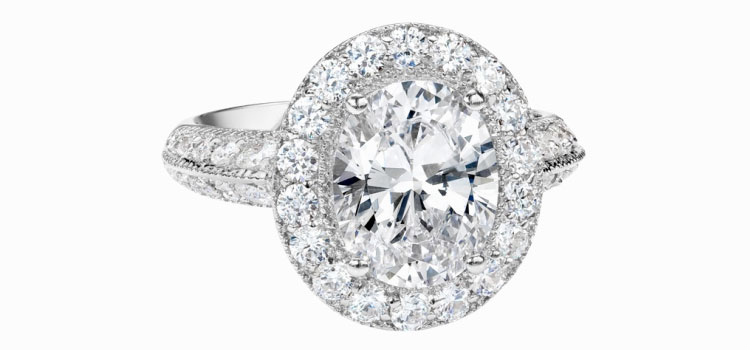
Everyone knows that diamonds come from deep inside the Earth and were formed over many, many years, but what about simulated diamonds?
Cubic zirconia is a simulated , man-made gemstone that first came onto the market in the late 1970s. At the time, no one had seen anything like it before. Here was a gem that looked reminiscent of diamonds. In fact, the highest quality “CZ,” as it is often called, looks so real that almost no one can tell the difference. Russian Formula CZ can look so much like “a girl’s best friend” that even experienced gemologists can have trouble discerning the difference between the two.
Because these stones that so uncannily resembled diamonds were so new, they immediately took off in popularity. Sales were high, and prices reflected that demand. Today, however, you can buy a beautiful piece of CZ jewelry at an inviting price. But that’s not why these stones were made to begin with. Let’s take a trip down memory lane.
Where Did It Come From?
A natural form of the synthetic stone was first found in 1937 by everyone’s favorite dynamic duo of German mineralogy: M. V. Stackelberg and K. Chudoba. OK, so they weren’t exactly rock stars, but the two were responsible for unearthing some interesting microscopic grains that were so interesting that they, well, didn’t even bother to document at the time. X-ray diffraction would, however, later prove that these were the natural equivalents to today’s synthetic diamonds.
A few decades later, the first simulated cubic zirconia stones weren’t made to be worn on your finger. Or to hang off your wrist, ears or neck. Nope, they weren’t made to be used in jewelry at all. The first cubic zirconia was made in Russia for use in laser technology. Facing a shortage of the natural rubies it needed to generate laser beams at the time, Russia got to work creating an alternative. The result of their research and development was cubic zirconia, a stone that is not actually particularly close to a ruby gemologically, but one that has all of the optical qualities the Russian laser tech of the time needed.
It wasn’t long until someone asked a rather brilliant question: what if they used these CZ stones in jewelry? Everyone then quickly realized that CZ indeed looked a heck of a lot like diamonds, a truth that had been staring them in the fact all along but had slipped by their laser-focused minds.
What Is It?
Cubic Zirconia is a bit of an oxymoron. Zirconium is a metal that crystallizes in the tetragonal crystal system into the form of the gemstone zircon. That being said, zircon is a zirconium silicate, but a cubic zirconia is a zirconium oxide. Are you with us so far? Great.
So why is all that important? Because by switching the oxygen for the silicon, the zirconium metal can be made to crystallize in the cubic crystal system. Adding a tiny bit of calcium or an element called yttrium can force stabilization of zirconium metal into crystals. Since diamonds are also cubic in crystal formation, any real diamond imitations must be cubic in order to look real enough to fool the eye.
The whole process requires heat…like a lot of heat. Things need to get so hot, in fact, that there is no crucible or container that is able to withstand the temperatures. Platinum won’t even do the trick. And that’s the reason why cubic zirconia wasn’t mass produced for the jewelry industry until the late ‘70s.
So, how is it done today? Just ask Lean Cuisine or Weight Watchers.
That’s right – it was the microwave that made it possible. In a delightfully cheering-sounding process called “skull melt,” the material itself makes its own crucible when microwaved. Since microwave ovens heat from the inside out, the outside of the material can stay cool while the interior gets incredibly hot.
What Are They Like Today?
But that’s enough about the past and the technical details. Now that you know where they come from, let’s explore where they are today. CZ jewelry comes in a wide variety of colors: pink, green, purple, champagne, blue, orange and colorless. They can also be cut into just about any shape: oval, emerald, radiant, asscher, princess, marquise, trilliant, etc. It costs roughly a tenth of the price of natural diamonds and looks so much alike to them that even jewelers can’t see the difference with the naked eye.
So that covers color, but what about the other three of the Four C’s? Cubic Zirconia is nearly flawless, and it is the rough equivalent of Grade F on the diamond clarity chart. Real diamonds have internal inclusions and/or external blemishes, but CZ stones are so close to perfect that they might as well be.
As for carats, that’s one place where they differ quite a bit from diamonds. CZ is approximately 75 percent heavier than comparative diamonds and is measured in millimeters for its diameter. That means that a cz stone will weigh in at something like 1.7 times the weight of a diamond of the same size. So while a 6.5-millimeter cubic zirconia is the same size as a one-carat diamond, it actually weighs about 1.75 carats.
Birkat Elyon carries only the finest cubic zirconia jewelry available, since all our pieces feature stones made from the Russian Formula. And thanks to our affordable prices, everyone can realize the dream of owning beautiful diamond-like jewelry.